





September 2, 2026
The Story Behind The Corporate Travel AI Network

Adam Braun
Co-founder
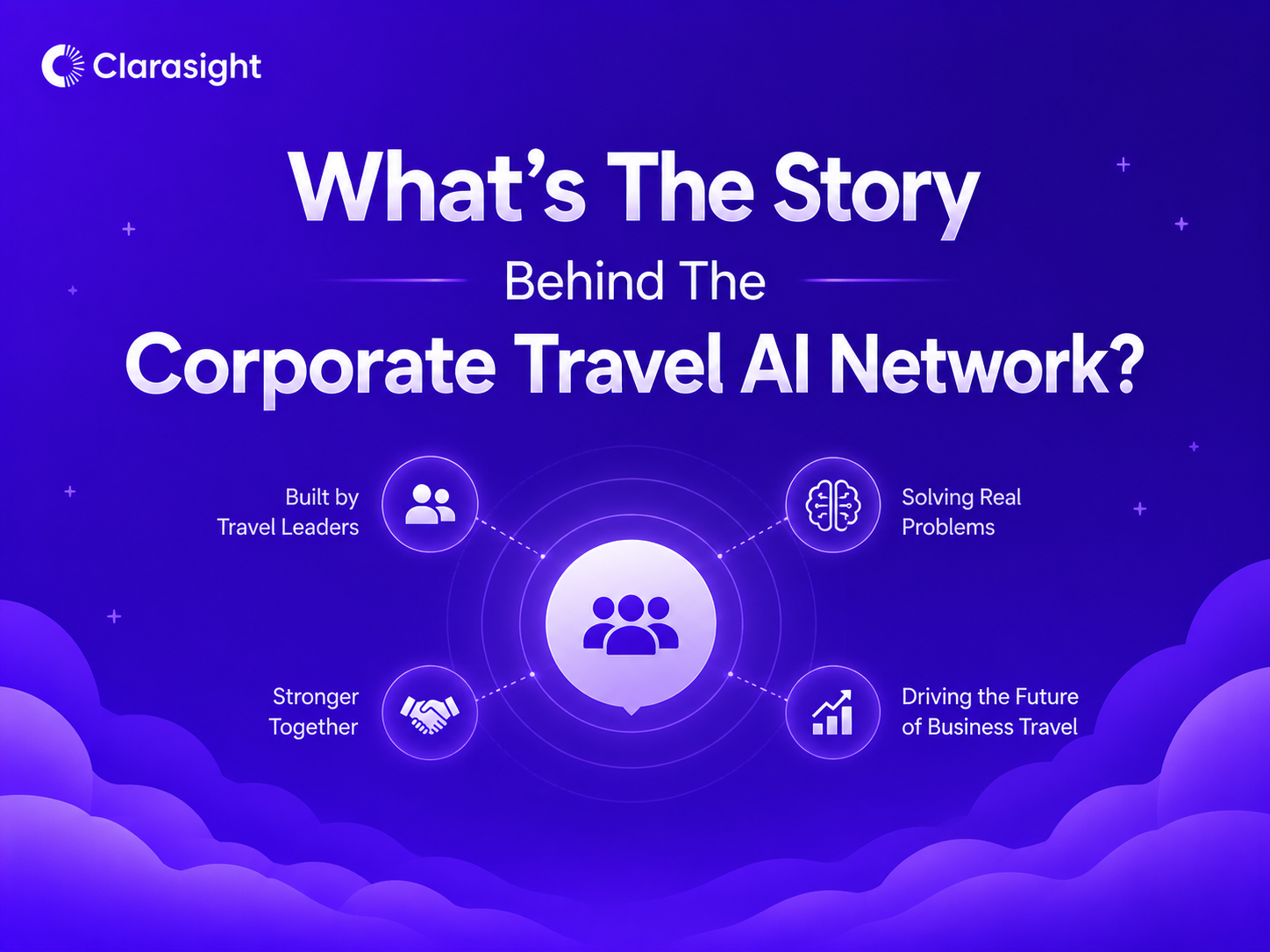
This is the story of building the Corporate Travel AI Network (apply here), the learning community of 350+ travel leaders building the future of enterprise travel.
I've spent much of my life building communities around moments of change.
What’s most drawn me in has been the moments when the old way of doing something no longer quite fits, while the new way hasn't fully revealed itself yet.
Those moments can be uncomfortable. They can also be incredibly exciting, because they create an opening for people to decide what should come next.
I felt that when I founded the global organization Pencils of Promise nearly 18 years ago. I was 24 years old, working at Bain & Company, and had spent much of my early twenties backpacking through the developing world. On those trips, I had gotten into the habit of asking one child in each country a simple question: If you could have anything in the world, what would you want most?
In India, I asked that question to a young boy begging on the street. His answer was a pencil.
I gave him mine.
It was such a small act that it almost felt insignificant. But I watched his face light up, and something shifted in me.
I had spent most of my life believing that meaningful change required enormous resources, influence or authority. That moment showed me you could start much smaller, through one act of commitment, and see where it led.
A few years later, Pencils of Promise began with $25 in a bank account and has since grown into an organization that’s built 600+ schools around the world serving 300,000+ students.
You rarely know at the beginning what something can become. You just know that a problem matters, that people feel it deeply, and that someone should take the first step.
When I first entered the corporate travel industry, I was an outsider. I didn't have decades of experience in travel. I didn't come in knowing all of the acronyms, systems, relationships or accepted ways of doing things. What I did have was curiosity.
So I started asking questions.
And I listened.
I spoke with travel leaders responsible for enormously complex global programs, often with surprisingly small teams behind them.
I heard how much time was spent gathering data, reconciling systems, building reports, responding to requests and trying to make sense of information scattered across a dozen different places.
But increasingly, another topic kept finding its way into those conversations: AI.
There was enormous curiosity, but there was also massive uncertainty.
People knew this technology was going to matter. Their CEOs were talking about it. Their companies were investing in it. They were experimenting with ChatGPT or Copilot themselves.
But when it came to the actual work of running a corporate travel program, there wasn't yet a clear playbook.
What struck me most wasn't that people didn't have the answers.
It was that everyone seemed to be asking the same questions and seeking the same answers, separately.
So we decided to create a shared space through the Corporate Travel AI Network (CTAN), where the learnings would happen together and in an accelerated way.
Our initial ambition was modest. We thought maybe 15-20 members would join a free community where travel leaders could be candid with one another.
No vendors pitching. No need to pretend you had figured everything out.
Just travel buyers learning from other travel buyers, with access to people and tools that could help them move faster.
Then something happened that we hadn't expected.
People kept joining.
Twenty became fifty. Fifty became one hundred. Then two hundred.
Today, more than 350 travel managers are part of this community.
I've had the privilege of personally speaking with hundreds of members via the personalized onboarding call we do with each new joiner, and those conversations have changed my understanding of what we're actually building.
Because CTAN isn't really about AI.
AI is the catalyst.
What this is really about is individual empowerment.
We're living through one of those rare periods when the way work gets done is being rewritten in real time.
Jobs will change. Entire workflows will evolve drastically. Things that consume hours today will eventually happen in seconds. And many of the assumptions people have built their jobs around will look completely different ahead.
I don't want travel leaders to experience AI as something that simply happens to their profession.
I want them to help shape what happens with it.
I want the person who understands the realities of a global travel program better than anyone else to have the confidence to build an AI workflow themselves.
I want someone who has spent ten years developing judgment about policy, suppliers and traveler behavior to realize that AI doesn't make that expertise less valuable. It can make that expertise dramatically more powerful.
And I want those people connected to one another.
There is a mythology around innovation that I've never particularly believed in. We tend to tell stories afterward as if one visionary person saw the future perfectly and then created it.
My experience has been much messier and much more human.
What I’ve witnessed is that someone identifies a seemingly distant trend that’s headed their way. Someone else notices it too and has ideas. A third person challenges it. People experiment. They fail. They share. They try again.
Eventually, enough people begin moving in the same direction that what once seemed improbable becomes inevitable. That's how movements form.
And maybe that's the word I've been hesitant to use with CTAN because it can sound too grand for something that is still so young.
But increasingly, that's what I believe this can become.
Not a movement around a single person, organization or product. But rather a movement of people who believe corporate travel can be fundamentally better and who are willing to help one another co-create what comes next.
On October 13 in New York City, we'll bring this community together for our first flagship summit.
It's free to CTAN members, and we're calling it Jetstream '26 (register here).
We're still early. We're still learning. We're still figuring out what this community can become.
But 350 people have already chosen to figure it out together.
And I have a feeling we're only getting started.